Thursday, July 24, 2014

11:00am 7/22 - 12:00am 7/24: In Constant Motion

SFO 11:00am 7/22
Full of excitement and anticipation, I boarded the United Airlines flight en route to Istanbul, Turkey, via Frankfurt at 2:00pm on July 22nd. After 14 hours at 35,000 feet (mix in 3 hours of sleep (in snatches), and 4 hours walking through the maze that is Frankfurt Airport), I arrived at Ataturk Airport at 5:00pm Wednesday, July 23. In Turkey. Another world. Turkish words immediately began swimming through my head, but I was unsure what half of them meant. Nukte appeared among the waiting crowd, familiar and smiling - what a strange thing after so many hours in limbo, landing halfway around the world, to be plucked and recognized. Home. 

I've known Nukte for 28 years. 
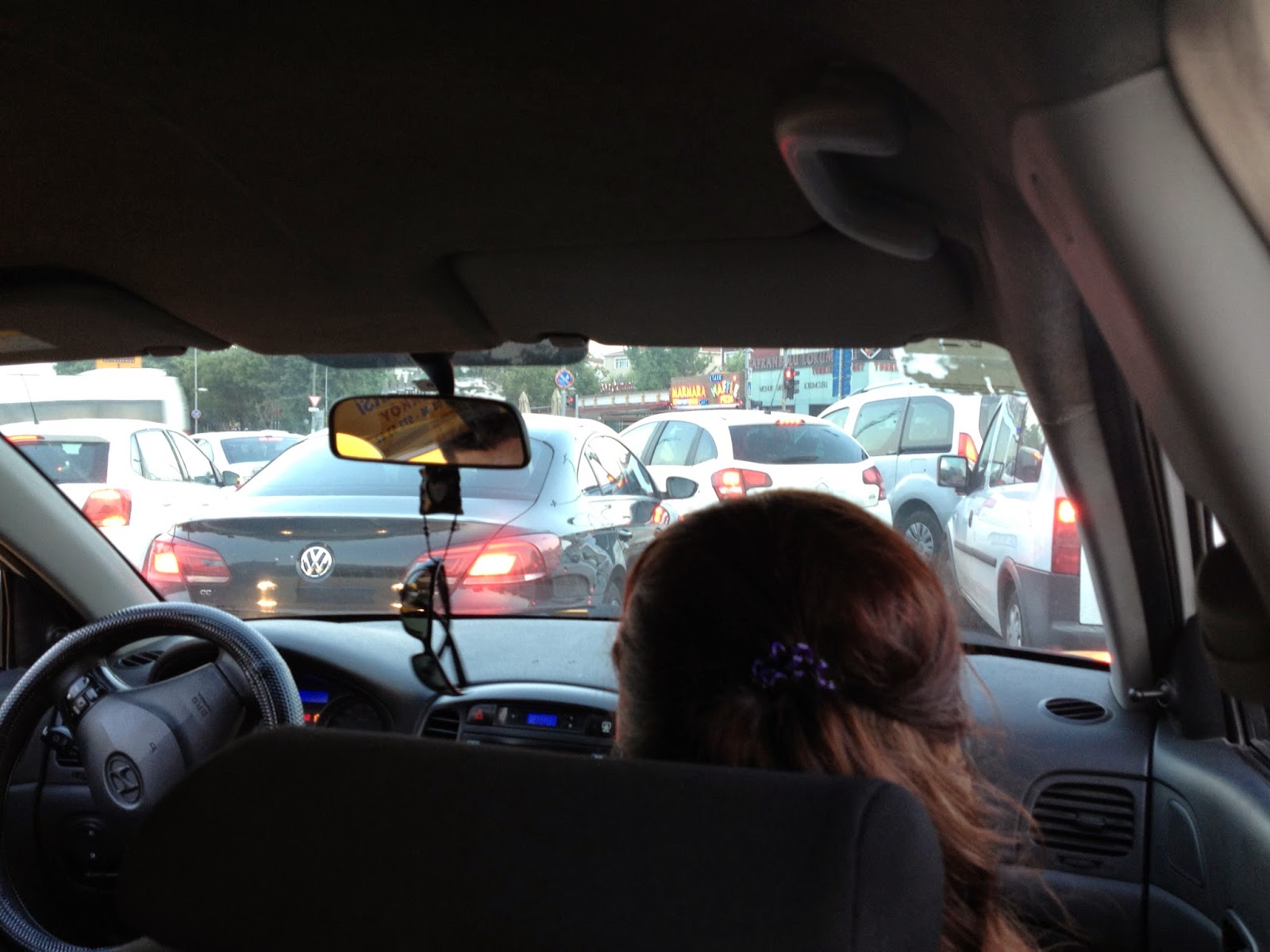
Driving through Aksaray, there traffic was arriving from 
all directions, with no sense of lanes at all.
Our first adventure was to find my mother, who had arrived in Istanbul that morning. A tour company in Tehran had set her up in a hotel in Aksaray, the armpit of an otherwise beautiful city. It was a trash hotel surrounded by other trash hotels, and a McDonalds. She was miserable. As soon as we called to say we were coming to get her, she repacked her bag and sat on the curb with her chin in her hands. It took us two hours to find her (subway connections, taxi, stopping passersby to ask the location of hotel), and when we pulled up to see her sitting there, it was a memorable sight. We swooped her up and off we went. It was now 8:00pm.


Success!
The ferry boat to Burgaz Island ("Burgazada") was leaving from the Kadikoy ferry landing at 9:30pm. We arrived with enough time to have a cup of tea before boarding. How glorious, an Istanbul ferry boat ride on a warm summer evening, the lights from the princess island glowing like jewels floating above the water. The air was heavy, wet and warm, but the air moved swiftly over us as we stood on the deck of the ferry. I found it ironic that I know to watch out for pickpockets and beggars, and yet passengers leave their suitcases near the exit of the ferry, and move about the upper levels without a worry about someone taking their bag. The ferry pulled in at 10:30pm. I had been traveling for 23 hours and was still in my traveling clothes. The ferry's engine was a loud hum as we moved through the Bosphorus to the Marmara Sea.

Burgaz Island allows no cars, and Nukte's summer house is at a high spot, several long and tall blocks up from the dock.


My mom, and my suitcases, were not going to have an easy time of it, so we hired a horse and buggy. 25 Turkish Lira.  My suitcase was heavy and took up an entire seat, so Nukte said she would walk. Walk? I immediately got nervous: it would be my mom and I on a horse and buggy being delivered to a house I had never been to before by a driver who spoke no English, in the dark. Against the clip clop of the horses hooves, as our buggy navigated the narrow alleyways by people enjoying a late stroll, or a seaside cafe, I began composing what I would say in my head. "Bey Effendim, hangi ev? Burdami?" Sir, which house? Is it here? He stopped at a vegetable stand to pick up his grocery bag, and continued on up the hill. Up, left, right, we were pulled by two white horses that were hoping, as I was, that their day (and mine) would end soon. The cart stopped suddenly and, nervous, I jumped out. "Hangi ev, Bey Effendim? Burdami?" 

The stream of Turkish that he responded with poured over me like a bucket of cold water. I had no idea what he was saying, except I was fairly certain he was not pointing out a house. "Are we here?" my mother asked. "I don't think so," I replied, and climbed back in the buggy. Up, left, right, and higher we climbed. Again the buggy stopped. And again I repeated the collection of words that I hoped would lead me to a bed. Again he rattled off a response at a rate that my brain couldn't follow. "What's going on? Are we not there yet?" my mother said, incredulously, and she laughed as I climbed back up confused. On and on we went, and for yet a third time we stopped. I waited for as long as I could stand, and then hopped out, asking "Burdami?" It's got to be here, I thought to myself. How much farther can it be? When I climbed back in to the buggy for the third time, my mother laughed uproaringly as I sat there a bit shame-faced. I had to admit I didn't know what I was doing and I was completely at the mercy of this middle-aged buggy driver. I sat back and resolved to not say another word. This entire ride took maybe 15 minutes, but we finally pulled up to a curb to find Nukte's husband Vincent waiting for us. Finally.we.had.arrived. And I think I could be sure this time. The driver was evidently as frustrated as I was as he related the story to Vincent in Turkish. He didn't know what to make of me: a nervous American jumping out of the cart every time he needed to give his horses a rest, or set the break for a downhill stretch.

Whew. 11:00pm. A soft bed. A meal, close friends. And a veranda that displayed the Marmara Sea spreading out before us.  It was at 4:00am, when I struggled to sleep, that I heard the Muezzin, mixing with the sound of seagulls at the dock. Listen with me here
This is the view I woke up to the next morning.


Monday, July 21, 2014

I'm leaving for Istanbul tomorrow at 2:15pm!!
Stay tuned for my posts.

Sunday, March 10, 2013

        My memories of Iran had already faded by the time I was seven years old so when the trunk arrived one fall day in October I was awestruck. It arrived on our doorstep like a long forgotten relative, encased in metal and lacquered wood, shredded rope wrapped around its belly and our address plastered to its top in my father’s careful script. The heavy iron handles lay flat along its sides like tiny round arms, worn and smooth in my hand. This was the lost trunk that my parents had sent ahead before our return. They had considered it lost, gone forever, and yet here it stood after having had travels of its own.

        It must have taken both my parents to lift that trunk. I imagined them holding those heavy handles, surprised by the weight of them, and then a noisy heave as they brought the trunk over the threshold. They would have carried it slowly through the dark hallway and down the carpeted stairs to our rumpus room, calling out to each other when they turned the corners. But I wasn’t there to see any of that. It was already enthroned in the deep shag of our rumpus room floor by the time I got home from school, and I found it there, waiting for me.

     The things that usually littered our rumpus room: my father’s massive canvases leaning against one wall with only the blond wood frames and frayed canvas edges exposed, the black upright piano with its bench settled underneath, and the old zenith TV on its rolling cart, they stood at attention around the trunk as if eyeing it, challenging it. Who goes there and what right have you here, you unexpected and uninvited stranger?

      Iran had become an “other”, foreign, strange, the half of me that was oddly-colored and smelled of celery stew and rose water; the half of me that I tried to ignore. My year there when I was three and four was like a closed chapter of one of my father’s library books full of black and white pictures of artifacts and statues. All that was left were flashes of memory: paper schoolbooks that I couldn’t read, pots of steaming rice and the bright orange of a glass of fresh carrot juice. Iran had become the sound of my mother’s shouts in to our kitchen princess phone on New Years Day each year; her voice desperately reaching through the phone, her loud voice shouting in the language that was familiar yet incomprehensible to me now. Iran was the phone inevitably handed to me to hear a tinny distant voice calling my name in answer to my small hello. The awkward silence when I didn’t know what else to say.

     And when this trunk was finally opened it brought forth all these things in a flood that made me breathless. Its heavy rope was cut with our kitchen knife and fell away to expose the heavy padlock that had been hidden underneath. Within minutes my father produced the small key and the top was lifted. Stale air mixed with the smell of sweet moth balls lingered in my nose as I stretched my neck to peer inside. Its dark gut was still and full. My mother, chatty, exuberant, welcomed each item from its depth as she gingerly removed them– small folded rugs with bright patterns, tiny sheep skin hats that I could hardly believe I had ever worn, a tin samovar with small matching tea cups, clothes, wraps, shawls and stiff beaded shoes of gaudy colors. I stood away and poked at these things with outstretched fingers. Everything was scratchy against my skin and the old, weighted smell was so strong it assaulted me and filled the room. I gladly disappeared into the kitchen to make my mother a cup of strong black tea and leave her with these smelly and unexpected relatives. Mother surrounded by memories

     Satisfied that she had unfolded each item, caressed each with nostalgia and longing and then refolded them with the same creases, Mother began returning them back to their waiting vault. The trunk which witnessed this whole scene was eventually closed with a slam and my mother sprang up from her squat with a light step. Both of my parents seemed to welcome this trunk home. As for me, I was wash with relief when it was all over: the foreigness of these things only served to remind me of my own unexplainable foreigness. The trunk finally took its rightful place amongst the old boxes in our garage and I felt more at ease with its place there, hidden and unseen. Its contents would remain the assemblage of an unknown people. Artifacts of a culture, of a part of myself, that I would never truly know.

Monday, March 8, 2010

On June 3rd 1971, my father left Iran for Europe and on July 18th my mother joined him in Rome. For 20 days Lygeia and I were left in the care of our grandparents in Tadjrish.

Over the 10 months we had lived in Iran, I committed to memory the changing landscape of our inner courtyard garden. I watched my Grandfather grow sick and almost die, and then, miraculously, claim a second chance. Ten months was a lifetime and I knew no other life.

August 7, 1971
En route to Zurich Switzerland

At 30,000 feet we had lost all sense of time and place. My sister’s wadded cardigan was pressing marks into my flushed cheek so I shifted my elbow out of the crack between the airplane seats and readjusted my head. The rumble of the jet’s engine interrupted my sleep – I was tired and bored and wanted this in-between world to give way to whatever was coming next. Through the ochre of closed lids I listened for my sister’s voice, but both she and our escort, Uncle Hossein, who wasn’t really our uncle at all, were quiet. Uncle Hossein spoke no English or German, so Lygeia had translated for him when the stewardess came by to offer blankets and pillows. He wasn’t as bold and confident as he had been at Grandpapa’s parties. Instead, he seemed strangely timid in stockinged feet and a black suit, having to ask my sister to get him a glass of water.

Hours later I was back in my parents' arms and dozing off and on through a cab ride. I was placed on my feet and led with half closed lids through a carpeted foyer, and on to an elevator (ding!) to my parents’ hotel room. For once, I did not argue who should push the button - I was far too tired to care. We would stay one night before a train ride to Frankfurt and another long flight across the Atlantic and back to the mythic Home. Home? The word rang flat. I waited for my mother to place the large iron key in the keyhole, and turn the lock in the hotel room door.

“We have a surprise for you,” my mother said, and pushed open the door.


“A surprise?” Lygeia asked and rushed over the threshold as the light was clicked on. I followed her past the large bed where my parents were to sleep, and through another doorway in to a smaller room where two twin beds sat side by side. The curtain was pulled open and the afternoon light poured down on an array of toys, purses and trinkets on each bed, of glorious reds, blues, yellows and greens – dolls with flowing dresses, a plastic purse of bright yellow and red, a Spanish flamenco dancer with a gown so full that her tiny plastic high heels were all but invisible to my eye. I dropped my father’s hand and rushed in with Sissy, wanting to grab it all at once into my arms. “For me? All for me?” I asked.

“This bed is for you Roia. That bed is for your sister.”
“Oh!” Lygeia squeeled, and we both rushed in to finger the cloth of the swiss apron we were both given, and the ruffles and the hair of each doll. From headboard to foot, it was a fantastic array, like Christmas, and the presence of these inanimate trinkets soothed me and reminded me of the awesome power of my parents to provide for me – to find me when I am lost. The weight of each doll in my hands was like another anchor to remind me of Home.

I turned over the flamenco dancer and studied her tiny shoes, her underclothes. I felt the plastic of my colorful and shiny purse. My mother and father eventually disappeared in to the next room to put down the suitcases but I hardly noticed.

“Sissy, look at this one!” I said with a grin, holding out the purse for her to see. She looked up briefly and went back to studying the long blond hair of the doll in her hands. She’d made room for herself on her bed, and had sat herself down amongst her prizes, her long legs extending off the end of the mattress.

Later that evening we sat at dinner in a dimly lit hotel restaurant. I had my new purse tucked tightly under my arm as I fell asleep in my chair. I let myself be carried back to our room for a long sleep in between cool sheets.

-end

Sunday, February 7, 2010

Sweet surprise

From the back seat of the taxi, I am barely big enough to see out the dirty windows: squares, rectangles and blocks of concrete reach up in to a grey, muddy sky. Heads turn to follow us as we wind sharply through noisy Tehran streets, honks blast, voices call out, my mother yells directions to the driver. I watch the long ashen tip of her cigarette pulse red, visible from the open passenger window, and feel the smokey breeze, passed back to me, brush against my forehead.

With a force that throws my shoulders forward, we have pulled over and stopped. Brief stillness, and then an eruption of voices, grown-ups, bills counted and passed to the driver, and my father's arm reaches across me to open the door. I hesitate, and then step down to the sidewalk in buckled patent leather shoes, careful to avoid the dirty canal of water directly below my feet.

The smokey air of the taxi has dissipated, but the breeze that blows by me now holds its own smells, both sour and sweet, aged. People stream by as I reach for my father's hand, the scene is black, dusty suit jackets and muted colors broken only by brightly colored headscarves tied under chins. A shrouded figure passes closely, with a hand holding that of a small boy. How can this child know his mother from any other figure, this sea of strangers, with only the one hand to know her? I ask myself.

I am tugged forward towards an open door. I know we are supposed to meet someone - whom, I don't know. I am a follower and subject to the whims and distractions of adults. I have no reason to expect otherwise.

There is darkness inside, as our eyes adjust, which soon gives way to tall chairs, a long bar, and the slight sting of more smoke. I feel my father's hands lift me into his arms, and he sits me on a tall padded stool. My fingers search for edges to cling to. On the other side of the bar is a flurry of activity, people moving quickly, and a machine rumbling very loudly, dripping a vibrant orange liquid in to tall glasses. The smell of sweet carrots. I watch, my head cocked slightly, as the men with dirty aprons work around the machine, sometimes blocking my view. Eventually, one turns and places a glass of orange liquid in front of me. It's of carrots, I know this. Warm saliva begins to pool in my cheeks as I wrap my hands around the cool, tall glass.

"Roia," my father says. "Try this."

Saturday, November 7, 2009

Care

First my father and then my mother were gone, but I do not remember the leaving. I do remember the absence of them though, the strange calm that settled over me when I believed that my life had irreversibly adapted to new routines, different fingers to sift through the tangles in my hair, different lips to kiss my forehead when the lights were turned off at night. How long would they be gone? I had no way to understand these things. As always, my sister was my rock, and I was calmed by her steadfast confidence, and soon just stopped asking the questions. It had been 8 months since we had arrived in Iran which was a lifetime of days and naps and dinners and breakfasts in the courtyard. The crisis of my grandfather's illness had passed as mysteriously as it had come. Life was constantly redefined.

The phrase “jeesh dahram” earned me a trip out to the toilet room which was across the courtyard outside and not in the house. I never visited that drafty room alone, unable to reach the slender chain that hung from the bare bulb above my head. I had long since adapted to the low crouch over the white porcelain hole in the concrete floor, and the strain to see over my pants wadded at my knees to watch the stream of yellow emerge from my body. I would say “tamom,” when I was through, and then felt warm water being poured over my bare skin from the long arched spout of a plastic water pitcher.

In Iran, just as there were not toilet seats, there were also no bathtubs. I became accustomed to taking showers with my Aunty Mary and baby cousin, clothes shed outside the door and water beginning to fall all around me in a tall tiled room with a drain as big as my hand in the middle of the cool floor. Aunty was thin, and she stood over me, as she held my baby cousin’s slippery body close to her breasts.
“Come on, joonam, you’re not afraid of water are you?” Her voice echoed off the dripping walls of the cavernous water room, and tried to lure me from where I stood. With her arms full of squirming baby skin I knew that, for the moment, I was in charge even though I was fearful of the way that water burned my eyes when it dripped down my face. I did not move my feet as I watched how their silhouette against the high window made their faces dark, and steam swirled around them. I felt the warm water circle around my toes as it moved across the floor. I waited until my turn to be in charge was over, and baby Mariam was handed to the towel and arms that emerged in the doorway. I let myself be picked up and lifted to the soft breasts of this woman, draping my arms over her shoulders and nesting my eyes in to the warm skin of her neck.

“It’s not so bad, is it, my dear,” I knew she was saying to me in her voice that was different from my mother’s, and for the time it took her to wash my back with her scratchy cloth, I was her baby, and I belonged to her. I let her place me back on my feet, and looked past her long dripping lashes into her brown eyes as she picked up each foot, resting it on her crouching thigh, and moved the sudsy cloth between each of my toes.

Saturday, October 31, 2009

Prayer

Dear persianchyld readers:
My apologies for not writing for several months. There have been big changes in my life - good ones - and I now plan to start up again. Thanks for hanging in there with me.


Tadjrish,Iran
June 1971

It was thirst that drove me down that dark hallway. As I passed the bedroom doorway I caught her shadowy figure out of the corner of my eye – my grandmother, with her back to me. She stood facing a blank wall, ghostlike, wrapped in her thin cotton chador adorned with a delicate pattern that I knew would be gathered closely under her chin. I cocked my head to one side. Her prayer reached my ears and it made me stop and linger there with my small fingers wrapped around the doorframe. I watched her raise her hands, palms up, as high as she could reach, and then cover her face with the invisible prayer. Then, quiet again, she knelt down and touched her forehead to the gather of beads on the small prayer rug at her feet. This odd ritual was repeated multiple times every day and I found her there often, as if asleep and in a dream state, following some mysterious pattern with half-cast lids. Entering the room and standing in her line of sight would not awaken her – I had tried that already – since she could tune out every person and sound around her and only listen to the sound of her own voice. Her feet were bare, and I could hear the soft crack of her bones as she rose from her prostration and stood tall and still again. There was strength in her stillness that I struggled to understand, a strength that seldom surfaced, but that made me stare at the rounded shoulders and the backs of her heels that poked out from under the light cloth.

Grandmama was a small woman - I could tell because my big sister was almost as big as she was. My grandmother’s voice never echoed off the walls like my mother’s could and she usually moved quietly about the house, shuffling in soft house slippers, tending to my grandfather’s needs, prepping the dinner, or brewing the tea. My Daddy had left Iran the week before, and it seemed my grandmother was putting me to bed as often as my mother now. The pads of her fingers always felt cool and soft on my face when she brushed my hair aside.

The routine began again and she shrank back down to the rug. I took a step to continue on my way to the kitchen, but the floor creaked loudly and I froze there, afraid to move. My eyes fixed on the curve of her back but I did not see her look up, did not see her break her trance to peak at who might be watching her. I did not move in the same world as Grandmama when she prayed, and it would take her another 20 minutes at least to complete the steps, and the prayers and to fold her chador in the prayer rug with the beads and the heavy leather bound book that she read from. My glass of water would have to wait, so I pivoted around to head back to my room, to climb on to my sister’s bed and wait.

Monday, July 27, 2009

A slice of America

Tadjrish, Iran
May 22, 1971

A table was delivered shortly after we arrived back at home from our trip to Mahabat: a rectangular table with six matching metal chairs that my mother had ordered for my birthday party before we’d left. I watched as my uncle removed the chairs from a mess of cardboard and plastic, with a cigarette hanging out of his mouth, squinting as the smoke reached his eyes.

Tall, pointy party hats were placed at each place setting, an army of beaming clown faces of blue, red and yellow smiling at attention. These things were very difficult to find in the Tadjrish bazaar: balloons, paper plates, colored napkins, party hats – and as the children filed in to the courtyard that day, children of adult friends of my parents and cousins, they crossed over in to my world, a little slice of America of my mother’s creation, within my grandmother’s stone walls. Throughout the day, American music played from the courtyard radio while mothers doted on children and fathers sat on garden chairs and smoked cigarettes with my grandfather, their long legs stretched out in front of them.

My grandparents traveled to Qom the next day, with my grandmother's brother, on a holy pilgrimage for a day of prayer. We were staying behind because it would be a strenuous hike, many hours on foot to shrines and tombs under the hot sun.

“Yah Yah, stay at home my brother,” said my great-uncle Diyee June. “You don’t need to come. The great Imam Ali would not want you to push yourself too hard. You look tired already – stay at home and rest.”
My grandfather had no intention of being left behind.

Grandpapa took his place in the waiting Peugeot, and I set about waiting out the long day till they would return. The sun finally inched its way across the sky and disappeared over the walls, but it was long after dark when I heard the car pull up. My mother followed the sounds out the gate to greet them, but when she emerged back in to sight, she was half-carrying my grandfather, his shoulders hunched and downcast. He didn’t speak, no winks or smiles, and he was helped into his dark bedroom and out of his clothes. To the sounds of hushed voices I was sent to bed, only to find my grandfather still in bed the next morning during the hour that he was normally enjoying his breakfast with me. My grandmother and my mother took turns visiting him in bed, making clear broths, and by lunchtime he was back in the Peugeot to see his doctor. This went on for days – no one left the house except to take my grandfather back and forth to the hospital until on the fourth day my grandfather did not return.

“Where’s Grandpapa?” I wanted to know.
“He’s sick, baby jon, the doctors are trying to help him.”

A week had gone by since my birthday and things had not returned to normal. My father’s departure date was only a few days away - but without encouraging news from the doctors about my grandfather’s condition there was little talk about it. Then, on the day my father was scheduled to leave Iran, we said our tearful goodbyes only to have him home again a few hours later because of a problem with his exit visa. Then, the morning of my father’s second attempt, on June 2nd, the phone rang in the early morning. My grandfather’s kidneys were failing him, he was unresponsive. My uncle feared that Grandpapa would not last the day. The adults spoke sharp words, batting them back and forth with furrowed brows, and the kitchen filled with the smoke of their cigarettes. I stayed away and played at the garden pool, trailing my fingertip in the dark water, hoping to hear the sound of a car bringing my grandfather back to me.

persianchyld.com


persianchyld.com
Originally uploaded by Roia

He was unwell, so weak, and when he could leave his bed he would remain in the plastic chair for long hours, dropping off to sleep.

Thursday, July 16, 2009

Sunshine

Tadjrish, Iran
Summer 1971

I watched my grandmother, squatting before a huge bowl of greens, picking through them with her delicate fingers. Preparation for dinner began just after breakfast, and could last throughout the day.

“Poffak Namakee?” I asked my grandfather. Most often he would oblige, pulling himself out of his chair with his cane and disappearing in the house to get this coat and hat. I ran behind my grandfather in to the house, calling out “Sissy! Ganpapa’s taking us fo’ Poffak Namakee!” skipping through doorways to find her. “Sissy!”

She emerged in the doorway. “He’s gedding his coat right now!” I said excitedly.

She pulled the door closed behind her and we both found our shoes by the kitchen door.

With my grandfather and my sister steadily making their way up the side alley alongside our tall garden walls, I danced, I skipped, and I made quick tottering circles around both of them. My mouth watered and I hummed to myself, and ran ahead to be the first to reach the doorway of the tiny shop. “Com’on!” I shouted back to them, hopping impatiently. The shopkeeper was there and he smiled down at me with his funny crooked smile, dark gaps where teeth should have been.

“Salom koochooloo,” he said - he always said - and I always gave him a “salom” back which always made him chuckle. There was not enough room to step in this shop, for it was only big enough for this man and his bright packages, small boxes and the big metal vat that held the Poffak Namakee. 

I loved to watch as he made me a white paper cone and scooped the cheesy puffs in to it until the orange peeked out the top of the paper. I always got mine first and could barely wait until that cone rested in my hand before I reached in to put the first one in my mouth. Closing my eyes, I let the warm, salty powder dissolve on my tongue, turning my tongue orange, and I sucked on the puff before I let my baby teeth grind it down. When I opened my eyes again, my sister was being handed her paper cone and my grandfather was placing two coins in the shopkeeper’s big palm. Our walk back down the alley was slower and my grandfather’s pace, as he leaned in to his cane, suited me fine as I stopped every second step to bathe my mouth once again in sunshine.